Website accessibility has become an important part of modern website development and digital marketing. Businesses are no longer focusing only on website rankings and traffic; they are also working to create digital experiences that everyone can use, including people with disabilities.
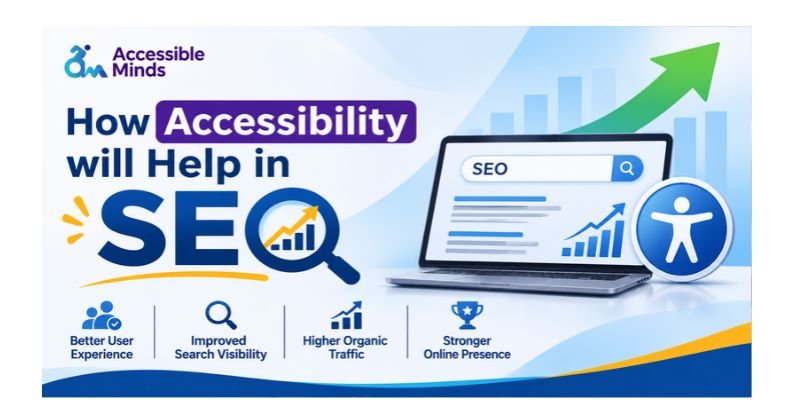
But how does accessibility help SEO? The connection between website accessibility and search engine optimization is stronger than many businesses realize. Several accessibility practices, such as descriptive image alt text, semantic HTML, logical heading structures, and mobile-friendly navigation, also support established SEO best practices.
Although accessibility is not a confirmed direct Google ranking factor, making a website more accessible can improve usability, content understanding, and overall website quality.
In this guide, we will explore seven ways website accessibility can support SEO and help businesses create more inclusive digital experiences.
What Is Website Accessibility and Why Does It Matter for SEO?
Website accessibility is the art of creating websites in a way that individuals with various abilities are able to interact with the site with no difficulty.
People with hearing, visual, motor, and cognitive impairments will struggle to use websites that lack accessibility features. For instance, a person who is utilizing a screen reader requires meaningful descriptions for the images on the site, while someone that is unable to use the mouse must use keyboard navigation.
Web Content Accessibility Guidelines (WCAG), developed by the World Wide Web Consortium (W3C), give suggestions on making digital content more accessible.
Understanding Digital Accessibility
Digital accessibility is mainly aimed at removing the barriers that keep users from accessing websites and apps. Several things contribute to accessibility such as readable text, forms, video captions, navigation via keyboard, as well as compatibility with assistive technologies..
How Accessibility and SEO Work Together
SEO allows search engines to find, interpret, and index information on the sites, while accessibility provides people with opportunities to access and take advantage of that content.
Both processes are supported by simple site design, useful headings, correct links, pictures posted correctly, and comprehensible information.
In case companies implement practices of accessibility and SEO, they can create user-friendly websites.
7 Ways Website Accessibility Can Help Improve SEO
Website accessibility supports several important elements of website optimization. Here are seven ways accessible web design can contribute to a stronger SEO strategy.
1. Improves Website User Experience
Experience in web usage is an essential factor in how a website performs. When surfing the internet, users expect to see proper functioning of websites, which includes loading and presenting information clearly and having an uncomplicated manner of navigation.
Making improvements in website accessibility such as using clear font for texts, employing consistent layout throughout the web pages, setting straightforward navigation menu, and ensuring easy-to-fathom buttons helps users to make their web experience less complicated.
For example, a website can be challenging for a person with limited motor skills if its buttons are not big enough or it is not possible to work with some elements on the web page using a keyboard.
Implementing the principles of an accessible design allows overcoming barriers and conducting seamless and pleasant web browsing.
Although better usability of a website does not translate into better ranking in Google, it still results in greater satisfaction, engagement, and conversion..
2. Improves Image Optimization Through Alt Text
Images form a crucial aspect of website content but search engines cannot understand every type of visual as humans do.
The alt text provides a written description of the picture. It helps screen reader users comprehend important visuals as well as assists search engines in getting more information about the visual content. For instance, a website selling furniture may use the following instead of generic alt text like “image123”:
“Ergonomic adjustable office chair with lumbar support.”
Effective image accessibility practices include:
- Write descriptive and relevant alt text.
- Explain the purpose of meaningful images.
- Avoid unnecessary keyword stuffing.
- Use empty alt attributes for decorative images.
- Keep image descriptions concise and useful.
Well-written alt text supports accessibility and can also help search engines understand image content.
3. Creates Better Website Structure With Semantic HTML
For web browsers, search engines, and assistive technology, Semantic HTML is essential as it makes it easy to interpret the layout and intent behind the content on its pages.
Different elements such as paragraphs, headings, lists, menus, and buttons convey important characters of various sections.
For instance, using the correct header such as H1 to indicate the main subject and H2 for other relevant parts gives certain continuity to the constructed piece of writing.
Important semantic HTML practices include:
- Use appropriate heading elements.
- Structure navigation with meaningful HTML elements.
- Use buttons for interactive actions.
- Use descriptive links.
- Provide appropriate labels for form fields.
A properly structured website makes content easier to understand and improves accessibility for visitors using assistive technologies.
4. Supports Better Mobile Accessibility
Mobile accessibility is one crucial aspect as most visitors visit websites using smartphones and tablets. A website that performs well on the desktop may still create accessibility issues on mobile devices.
For example, small buttons, illegible text, overlapping content, and complex navigation can create hurdles for mobile users.
Businesses should focus on:
- Responsive website layouts.
- Readable font sizes.
- Sufficient color contrast.
- Touch-friendly interactive elements.
- Accessible forms and menus.
- Proper spacing between clickable elements.
Google uses the mobile version of website content for indexing through mobile-first indexing. Therefore, maintaining accessible and functional mobile experiences supports both usability and sound mobile SEO practices.
5. Improves Content Readability and Navigation
Readability of content is essential for visitors and search engines alike; websites that are difficult to read, such as websites with complicated language, illogical navigation, or poorly organized content; these websites limit users’ ability to find what they seek.
Content that is readable employs simple language, meaningful headings, appropriate links and logical ordering.
For example, if a blog has a well-formed H1 header, relevant H2s and appropriate H3s, its readers are likely to understand the topic and find necessary information.
SEO specialists should also concentrate on proper anchor text instead of using standard expressions like “click here”.
Following these rules helps users navigate the site content.
6. Makes Multimedia Content More Accessible
Videos, podcasts, and other multimedia formats help businesses communicate information effectively. However, not every visitor can access audio or visual content in the same way.
Accessibility features make multimedia content more inclusive.
Important practices include:
- Add captions to videos for people who are deaf or hard of hearing.
- Provide transcripts for audio and video content.
- Include audio descriptions when important visual information is not otherwise communicated.
- Ensure media players are keyboard accessible.
- Provide clear controls for playing, pausing, and adjusting media.
Transcripts can also make valuable spoken information available as searchable text when published on the page.
This creates additional opportunities for visitors and search engines to understand the information.
7. Supports Website Quality and Technical SEO
Technical SEO emphasizes the accessibility of websites by search engines. By employing accessibility measures, one can support this process.
For instance, semantic HTML, clear navigation, structured content, and interactive elements can improve a website’s organization.
Accessibility testing shows problems like missing form labels, disabled keyboard navigation, weak color contrast, and bad interface components implementation.
Resolving these issues will have a positive effect on the user experience.
However, companies should remember that accessibility improvements can’t solve technical SEO issues by themselves as both branches need to be studied and improved..
Best Website Accessibility Practices for Better SEO
Businesses can implement several practical improvements to make their websites more accessible while supporting SEO objectives.
Follow WCAG Accessibility Guidelines
Use WCAG as a foundation for website accessibility. Its four main principles are:
- Perceivable: Information must be presented in ways users can perceive.
- Operable: Website functionality must be accessible through different interaction methods.
- Understandable: Content and navigation should be clear and predictable.
- Robust: Content should work reliably with browsers and assistive technologies.
Optimize Images With Descriptive Alt Text
Provide meaningful alt text for informative images and use empty alt attributes for decorative images. Avoid repeating keywords unnecessarily.
Use Proper Heading Hierarchy
Organize content using logical H1, H2, and H3 headings. This improves content structure and helps visitors navigate longer pages.
Improve Keyboard Navigation
Ensure visitors can access menus, links, forms, and interactive elements using a keyboard. Maintain visible focus indicators.
Make Forms and Buttons Accessible
Provide descriptive labels, clear instructions, meaningful button text, and understandable error messages.
How to Measure the Impact of Accessibility on SEO
Businesses should evaluate accessibility and SEO performance separately while looking for improvements across the overall website experience.
Use Google Search Console
Monitor organic impressions, clicks, indexing information, and search queries to understand how website visibility changes over time.
Use Accessibility Testing Tools
Several tools can help identify accessibility issues:
- WAVE: Identifies common accessibility problems on web pages.
- axe DevTools: Helps developers detect accessibility issues.
- Lighthouse: Evaluates accessibility alongside performance and other website quality factors.
- Google PageSpeed Insights: Provides performance information and related improvement recommendations.
Monitor Website Engagement and Performance
Review organic traffic, conversions, mobile usability, and relevant engagement metrics. Compare results before and after accessibility improvements, keeping in mind that many factors can influence SEO performance.
Why Businesses Should Invest in Professional Accessibility Services
The enhancement of website accessibility necessitates expertise, organized testing, and continual supervision. When companies solely depend on automated testing, it’s likely that some significant problems will go unnoticed.
Specialist accessibility companies can uncover issues through manual evaluation techniques, web accessibility testing, usability testing with screen readers, keyboard operation tests, accessibility audits, and WCAG checks.
Accessible Minds provides companies with assistance in achieving a more inclusive digital environment thanks to consulting and assessing based on accessibility issues.
By discovering accessibility deficiencies and implementing solutions, companies will end up with websites that are more user-friendly for disabled people.
Moreover, investing in professional digital accessibility solutions will make sure that accessibility becomes part of web maintenance for development and marketing teams.
Conclusion:
Both website accessibility and SEO have some common principles, such as clarity of content, clear structure, navigability, and ease of use. Moreover, website accessibility does not guarantee high rankings, but it positively affects user experience and SEO.
Companies should respect website accessibility as an ongoing element of the digital strategy since by using suitable methods and help from specialists like Accessible Minds it becomes possible to make websites more accessible and gain important advantages for the organization in terms of organic growth.
Frequently Asked Questions (FAQs)
Website accessibility supports SEO through practices such as descriptive alt text, semantic HTML, logical heading structures, and improved navigation. These practices help users access content and make website information easier for search engines to interpret.
Google has not confirmed website accessibility as a direct ranking factor. However, accessibility improvements often overlap with SEO best practices, including mobile usability, meaningful content structure, and clear navigation.
WCAG compliance does not guarantee higher search rankings. However, following WCAG guidelines can improve website usability, content structure, and accessibility, supporting several important website quality practices.
Alt text describes meaningful images for people using screen readers. It also provides search engines with additional context about image content, helping them understand relevant visual information.
Yes. Accessible websites offer clearer navigation, readable content, keyboard-friendly controls, and understandable forms. These features help people with different abilities interact with websites more comfortably.
Accessible web design supports mobile usability through responsive layouts, readable text, touch-friendly controls, and functional navigation. These improvements complement Google’s mobile-first indexing approach.
Web accessibility focuses on making digital content usable for everyone, while SEO focuses on improving search visibility. Both benefit from clear content, meaningful HTML structures, descriptive links, and organized website navigation.
Tools such as WAVE, axe DevTools, Lighthouse, and Google PageSpeed Insights can help identify accessibility and website quality issues. These tools should be combined with manual accessibility testing.
Screen reader compatibility allows people with visual impairments to understand and navigate website content using spoken or braille output. Proper headings, labels, landmarks, and image descriptions improve this experience.
Digital accessibility services help businesses identify usability barriers, evaluate WCAG conformance, test assistive technology compatibility, and improve website experiences for people with disabilities.