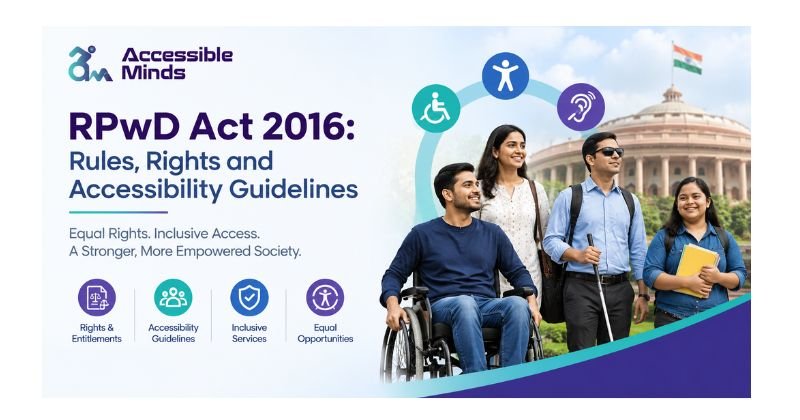
In order to develop an inclusive society where everyone can participate in daily life, accessibility and inclusivity should be the focus. The Rights of Persons with Disabilities Act, 2016 (RPwD Act 2016) in India is a major step forward, as it provides protection for the rights of individuals with disabilities and creates avenues for equal participation within society, promotes individual dignity, and guarantees access.
The Act covers numerous areas of life on a day-to-day basis including education, employment, public works projects, transit options and access to information and communication technology. Understanding the Act’s provisions provides an opportunity for individuals, business owners, educational institutions and government agencies to create inclusive environments.
In this guide, Accessible Minds will be discussing the most important sections of the RPwD Act 2016 (Rights of Persons with Disabilities), what rights are covered under the RPwD Act, the rules associated with the RPwD Act, and the accessibility guidelines that organizations need to be aware of.
What Is the RPwD Act 2016?
The Rights of Persons with Disabilities Act 2016 (RPwD Act 2016) is an Indian law enacted on December 27, 2016, to protect the rights of persons with disabilities and promote equality, dignity, and inclusion. The Act was developed in line with the principles of the United Nations Convention on the Rights of Persons with Disabilities (UNCRPD).
It replaced the earlier Persons with Disabilities (Equal Opportunities, Protection of Rights and Full Participation) Act, 1995, introducing a broader legal framework for safeguarding disability rights.
The Rights of Persons with Disabilities Act 2016 came into force on April 19, 2017. One of its significant changes was expanding the number of recognized disabilities from seven to 21. The Act emphasizes non-discrimination, equal opportunities, accessibility, independent living, and participation in society. It also supports the inclusion of persons with disabilities in education, employment, and public life, helping create a more accessible and equitable environment.
Key Rights Under the RPwD Act 2016
The RPwD Act 2016 establishes important rights and entitlements intended to reduce discrimination and remove barriers faced by persons with disabilities.
1. Right to Equality and Non-Discrimination
Section 3 discusses equality and non-discrimination. It provides for appropriate governments to make sure that disabled persons are equal, dignified and respected in terms of their integrity. Discrimination on the basis of disability is prohibited according to the provisions of the Act. Appropriate governments should also take steps to ensure that reasonable accommodation is provided when required. Reasonable accommodation refers to the alterations that need to be made so that a disabled person can practice their rights.
2. Right to Inclusive Education
The Act supports inclusive schooling and equality of opportunity for children with disabilities. This legislation requires educational institutions to provide inclusive and barrier-free access to educational services by providing necessary assistance to children. In accordance with Section 31 of the Act, in the age group of 6 to 18 years, children with specified disabilities are entitled to free of charge education. Under Section 32 of the Act at least 5% of places have to be reserved for such children in government and government-aided institutions of higher education, subject to applicable laws.
3. Rights Related to Employment
This Act is all about equal opportunities being available to everyone in the labor market and prohibits discrimination in government jobs following the relevant regulations. Section 20 provides for non-discrimination in the case of people employed in government locations. According to Section 21 all establishments should declare their equal opportunities policy as it should be prescribed.
Section 34 foresees a minimum of 4% quota for people having disabilities as defined by this Act in government bodies. Employers in the private sector are supposed to create an accessible recruitment process for people with disabilities, provide reasonable accommodations, and introduce an inclusive employment environment as well as some disability awareness programs.
4. Right to Accessibility
The main principle of the RPwD Act 2016 is accessibility. Sections 40 to 46 address accessibility standards regarding the physical environment, transportation, information & communication technology (ICT), and public services. Ultimately, the objective of the RPwD Act 2016 is to provide unhindered access to buildings, facilities, services, and information to all people who have a disability.
5. Right to Community Participation and Independent Living
The Act emphasizes the value of everyday community life. The Act also emphasizes the right of an individual to make decisions and to engage in society. There are many aspects to the Act. These include addressing harms and abuses. The Act addresses providing equal access to justice.
The Act provides assistance for recovery and rehabilitation. Finally, the Act provides time for rest and relaxation. The Act provides opportunities for individuals to attend cultural events and sporting events. Together, these rights provide a basis for creating a society that includes everyone. These rights are intended to prevent disability from creating additional barriers to independence and daily opportunities.
RPwD Act 2016 Rules and Regulations
The Act establishes the legal framework, while rules and notified standards help explain how specific provisions are implemented.
Rights of Persons with Disabilities Rules, 2017
The 2017 Rights of Persons with Disabilities Rules have been promulgated on June 15, 2017. These rules set forth the guidelines for the implementation of various processes, including the process for issuing disability certificates, implementing policies of equal opportunity and ensuring accessibility. Organizations should refer to these rules and their amendments rather than relying on the summaries of the law only.
Accessibility Standards and Guidelines
The provisions of Section 40 authorize the Central Government to establish rules and regulations concerning accessibility with the assistance of the Chief Commissioner for Persons with Disabilities. Requirements for accessibility depend upon the type and sector of the service provided.
Standards and guidelines developed by the Central Government are specific to each of the sectors: education, healthcare, banking, transportation, and Information and Communication Technology (ICT) firms. Agencies must understand the requirements applicable to their particular operations as well as updates to those regulations.
Responsibilities of Government and Establishments
The obligations are assigned to the concerned authorities which include the local governments, and organizations. Based on the requirements of the agreement, some of the obligations can encompass the development of infrastructure, making the provision of services where possible and implementing acceptable practices to comply with the regulations on accessibility. Thus, each organization needs to analyze its responsibilities in detail as sometimes the requirements may differ from one institution to another as well as between the organizations leading their activity in the different spheres of economy.
Guidelines Under the RPwD Act 2016
Accessibility isn’t simply an addition of a ramp or the modification of the architecture of a structure. Accessibility is about enabling individuals with different types of disabilities to utilize information, digital tools, communication with others, and services.
1. Physical Accessibility
Accessible infrastructure helps people navigate buildings and public spaces freely.
Key elements include:
1. Ramps for wheelchair access and step free entrances.
2. Sturdy lifts and wide hallways.
3. Disabled toilet facilities and parking.
4. Textured guidance and adequate signage.
5. Safe routes and walking paths.
It is important for organizations not to be complacent about meeting the standards of accessibility but to check its property against regulations.
2. Digital Accessibility
Digital accessibility provides people with various types of disabilities (including visual, hearing, motor, cognitive, and others) the ability to use websites, applications, text, and other online resources.
Some suggested actions are:
- Incorporating relevant alt text for descriptive images.
- Making sure that the keyboard navigation is possible with visual highlights.
- Subtitling or transcribing relevant audio or video material.
- Using proper contrast between text and background.
- Creating understandable titles, links and filling out the forms correctly.
- Verifying usability with popular accessibility tools.
Regarding online content, the WCAG presents a well-known set of recommendations. But it is also very important for Indian organizations to check all the special legal and industry-specific requirements concerning their online service.
3. Accessible Transportation
Accessible transportation allows individuals with disabilities to be able to move about on their own to go to school, work, and participate in other community based programs. Some of the most important components of this are having access to an accessible transportation system, being able to board the vehicle safely, receiving adequate information regarding the service being provided, and receiving support from the services providers when needed, depending upon the type of disability (mobility, sensory, etc.), and the industry standards for that particular mode of transportation.
4. Accessible Information and Communication
Section 42 talks about accessibility when it comes to information as well as communication technology and various technologies and systems related to it. Businesses and organizations support accessibility to their information through means such as providing information in accessible formats, utilizing digital documents that are accessible to the end-users, promoting means of communications, and allowing those with disabilities to understand the provided public information.
How Can Organisations Improve RPwD Act 2016 Compliance?
Understanding the legislation is the first step. Organisations must also translate applicable requirements into practical changes.
Step 1: Conduct an Accessibility Audit
Examine physical buildings and structures, apps residing on mobile devices, platforms being used for communication purposes with special emphasis on their material and service provision. Investigate problems that arise within the establishments and develop suggestions based on legal competencies, relevancy from the user’s perspective, as well as feasibility of implementation.
Step 2: Review Policies and Procedures
Analyze all aspects of recruiting processes, policies regarding provision of accommodations at work, client service procedures, complaint management, and equal opportunity policies. Check that all of these policies respect legislation on disabilities and are known by employees and others concerned.
Step 3: Involve Persons with Disabilities
Professionals who have been involved in the assessment process will lead to a better implementation of the accessibility review. The feedback that is received will help us find out other areas where we can make improvements, as many times these are overlooked by both computer software and regular compliance checklists.
Step 4: Train Employees and Teams
Organizations should provide regular training opportunities for human resources, design, development, customer service, maintenance, and management teams to help employees understand the importance of inclusive communication and reasonable accommodations in their daily work. By incorporating digital accessibility services into their accessibility initiatives, businesses can also help teams identify digital barriers, improve the usability of websites and applications, and create more inclusive experiences for employees and customers with disabilities.
Step 5: Monitor and Improve Accessibility
Accessibility is an ongoing task that does not end with the introduction of changes. What is imperative, is that the changes are executed and also tested for compliance with standards, monitored for amendments and effectiveness of implementation in digital and physical environments. It is furthermore advisable to seek legal and accessibility specialist assistance when applying for legal regulations that are subject to interpretation.
How Accessible Minds Can Support Accessibility and Inclusion
Accessible Minds utilize the principles of the RPwD Act, 2016, as an introductory context within which organizations may understand the challenges presented by accessibility and seek to address practical improvements. Provided the service, assistance would be in the area of digital accessibility assessments, website usability reviews, accessibility awareness, guidance on inclusive design and recommendation to improve the accessibility of digital experiences.
To bring about inclusivity in web site and online service accessibility, the first step for organizations is to recognize what barriers exist and establish a timeline for comprehensive improvement. An accessible experience is it all. Organizations do well to embrace accessibility as an ongoing commitment rather than a one-off activity for better usability, greater inclusion, and accessible services for even more people.
Conclusion
The RPwD Act of 2016 is a major milestone on the path to defending disability rights and turning our country into a more welcoming and accessible place. At its core are some pretty fundamental ideas – like the right to be treated equally, to get an education, find a job, have decent infrastructure, use the latest technology, and have a say in the community.
But just knowing the law is only half the battle – to actually make a difference, organisations need to overcome the obstacles and make real changes, like putting accessibility at the heart of what they do and working hand in glove with the people they’re trying to help. And that’s where Accessible Minds comes in – we can help organisations figure out how to make their digital solutions a whole lot more accessible.
Frequently Asked Questions About the RPwD Act 2016
1. What is the Rights of Persons with Disabilities Act 2016?
The Rights of Persons with Disabilities Act 2016, also known as the RPwD Act 2016, is an Indian law enacted to protect the rights of persons with disabilities and promote equality, dignity, inclusion, accessibility, and participation in society.
2. What are the main objectives of the RPwD Act 2016?
The main objectives of the RPwD Act 2016 are to safeguard the rights of persons with disabilities, prevent discrimination, promote equal opportunities, improve accessibility, support inclusive education and employment, and encourage independent living.
3. What are the key features of the RPwD Act 2016?
Key features include recognition of 21 specified disabilities, provisions addressing equality and non-discrimination, accessibility requirements, inclusive education, employment-related protections, and measures intended to improve participation in society.
4. What are the major provisions of the RPwD Act 2016?
The Act includes provisions concerning equality and non-discrimination, education, employment, social security, healthcare, accessibility, and enforcement. Sections 40–46 address accessibility-related matters, including standards and access to information and communication technology.
5. What is the RPwD Act 2016 in India?
The RPwD Act 2016 is India’s legislation for protecting and promoting the rights of persons with disabilities. It replaced the Persons with Disabilities (Equal Opportunities, Protection of Rights and Full Participation) Act 1995 and provides a broader framework for inclusion and accessibility.