Technology is becoming an essential part of everyday life, from business software and mobile applications to websites and cloud-based platforms. However, not everyone experiences technology in the same way. People with visual, hearing, motor, and cognitive disabilities may face challenges when using digital products that are not designed with accessibility in mind.
This is why digital accessibility has become an important consideration for technology companies. Organizations are increasingly expected to demonstrate that their products meet recognized accessibility standards, particularly when working with government agencies and enterprise customers.
One important document in this process is the Voluntary Product Accessibility Template (VPAT). It helps technology providers explain how accessible their products are and identify areas that may require improvement.
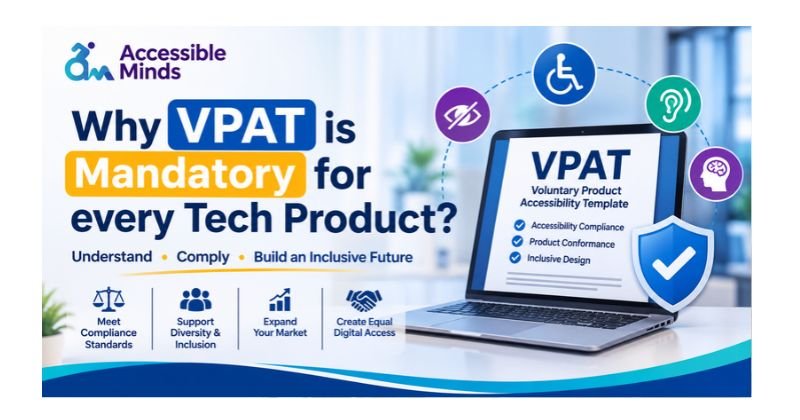
But is VPAT mandatory for every technology product? Although it is not universally required by law, it plays an important role in procurement, accessibility evaluation, and business credibility.
What Is VPAT (Voluntary Product Accessibility Template)?
The Voluntary Product Accessibility Template (VPAT) is a standard document created by the Information Technology Industry Council (ITI). It helps technology manufacturers to clarify how their products comply with specific accessibility criteria.
A filled-in VPAT is often referred to as an Accessibility Conformance Report (ACR) because it provides details about a product’s accessibility aspects, its disadvantages, and its degree of compliance with applicable guidelines.
Businesses use VPAT documentation for products such as:
- Software applications and SaaS platforms
- Websites and mobile applications
- Hardware and digital devices
- Enterprise technology solutions
- Cloud-based business platforms
Understanding the Difference Between VPAT and ACR
The VPAT and ACR are closely linked, but have different uses. The VPAT is a template used for reporting while the ACR is the actual report documenting the assessment of accessibility of that specific product. While using technology products, purchasing authorities such as government organizations and business buyers typically require an ACR to know if the product they are purchasing meets their required standards for accessibility.
Why Is VPAT Important for Every Technology Product?
Digital accessibility has grown beyond being just a factor in design. It has now come to be associated with legal requirements, client expectations, and opportunities for business growth. In this piece, I present a few significant reasons why technology firms ought to invest in the creation of VPATs.
1. Demonstrates Digital Accessibility Compliance
A report that conforms to the VPAT model shows how the product from a business meets generally known standards of accessibility. For example, where businesses are supplying technology products to federal organizations in the United States, they may be required to comply with Section 508 standards. The ACR gives procurement departments insights into the accessibility features of the product and indicates areas where the product may lack compliance. The document also reveals important information about how the product supports users of assistive technology.
2. Builds Trust With Enterprise and Government Buyers
In their selection of technology suppliers, large businesses pay more attention to the aspect of accessibility. The organizations want goods whose functionality will be available to people with all kinds of abilities, including their personnel and customers. A VPAT report that has been created properly presents the information regarding the accessibility. The report is very useful in evaluating products and comparing providers in the process of making any buying decision. Hence, the provision of accessibility documentation may be an important consideration in the work of such technology companies that deal with contracts either from big companies or government agencies.
3. Supports Inclusive User Experiences
Accessibility makes it possible for people with disabilities to use digital products on their own. For example, screen reader compatibility helps visually impaired people get website content, while keyboard accessibility allows those who cannot use a mouse to use the product. VPAT analysis is conducted to ensure that these accessibility features are in place and functioning.
4. Identifies Accessibility Gaps Early
VPAT analysis is capable of finding potential accessibility issues that can otherwise go unnoticed in the product design phase. By catching these problems early, developers can put more focus on improvements and also mitigate future usability problems caused by lack of awareness of accessibility issues.
Is VPAT Legally Mandatory Under Section 508 and WCAG?
Another naturally occurring question among tech companies is if there is a legal requirement for a VPAT. Well, the answer is ‘it depends’ on various factors including the product, market, applicable laws, and purchasing requirements. It is necessary to note that VPAT by itself is just a voluntary reporting format. Accessibility obligations come from laws, regulations, or contracts rather than from the VPAT itself.
Section 508 Compliance Requirements
Section 508 of the Rehabilitation Act mandates U.S. federal agencies to guarantee that the information and communication technology they create, acquire, manage, or utilize is accessible to individuals with disabilities, following all applicable regulations. Hence, technology vendors offering products to federal agencies must usually provide proof of accessibility. An ACR based on a VPAT is used by agencies to check if the product meets Section 508 accessibility provisions.
Understanding WCAG Accessibility Standards
The Web Content Accessibility Guidelines (WCAG), developed by the World Wide Web Consortium (W3C), provide internationally recognized recommendations for making digital content accessible.
WCAG includes three conformance levels:
- Level A: Addresses essential accessibility requirements.
- Level AA: Covers additional accessibility requirements and is a common compliance target.
- Level AAA: Represents more advanced accessibility criteria.
WCAG is frequently used when evaluating websites, software applications, and other digital products.
Does Every Technology Company Need a VPAT?
Creating a VPAT is not legally required for each technology company’s products.
However, in case of software, hardware, or digital services sale to government bodies or big companies, it might be necessary to offer an ACR.
Even though it might not be a strict requirement, the companies could benefit from keeping their accessibility documentation ready because it can help them build trust, find flaws, and aim for new opportunities.
Key Benefits of Having a VPAT Report for Your Tech Product
Preparing a VPAT-based ACR offers several advantages beyond procurement documentation.
Improves Business Opportunities
Accessibility documentation can help technology vendors meet buyer requirements and participate in procurement opportunities where accessibility evaluation is part of the selection process.
Strengthens Brand Reputation
Companies that prioritize accessibility demonstrate their commitment to inclusive technology. This can strengthen relationships with customers, business partners, and enterprise buyers.
Reduces Accessibility and Procurement Risks
Identifying accessibility barriers early helps businesses understand potential compliance concerns and plan appropriate improvements.
It also gives procurement teams clearer information before purchasing a technology solution.
Supports Better Product Development
Accessibility findings provide practical guidance to developers and designers. They can use these insights to improve navigation, interface elements, forms, multimedia, and compatibility with assistive technologies.
What Information Does a VPAT Report Include?
A VPAT-based Accessibility Conformance Report provides structured information about a product’s accessibility.
Typical information includes:
Product and Company Information
This section identifies the product, vendor, product version, report date, and other relevant details.
Accessibility Standards and Conformance Levels
The report evaluates relevant accessibility criteria under applicable standards, such as WCAG and Section 508.
Common conformance descriptions include:
- Supports
- Partially Supports
- Does Not Support
- Not Applicable
Remarks and Explanations
Vendors provide explanations describing how the product meets individual accessibility criteria. They should also disclose known limitations, accessibility barriers, and relevant testing information.
Accurate explanations are important because simply marking every requirement as supported does not demonstrate genuine accessibility.
How to Create a VPAT Report for Your Technology Product
Creating a reliable VPAT report requires a structured accessibility evaluation.
Step 1: Identify Applicable Accessibility Standards
Determine which VPAT edition and accessibility standards are relevant to your product and target market.
Step 2: Conduct an Accessibility Audit
Evaluate the product using automated accessibility tools, manual testing, keyboard navigation, and assistive technologies such as screen readers.
Step 3: Document Accessibility Findings
Record which accessibility criteria are supported, partially supported, not supported, or not applicable. Include clear explanations for each relevant finding.
Step 4: Prepare the Accessibility Conformance Report
Use the appropriate VPAT template to organize evaluation results and create an accurate ACR.
Step 5: Review and Update the Report
Accessibility is an ongoing process. Businesses should review their reports whenever significant product changes affect accessibility or relevant standards and requirements change.
Why Businesses Should Work With Accessibility Experts
Producing an effective VPAT report entails more than just following a template. Companies should have a clear understanding of accessibility principles, assess products for how they functionally perform, and accurately document the results of assessment.
Accessibility consultants can assist companies in conducting thorough evaluations of products , uncover existing obstacles, test the compatibility with assistive technologies, and guide the clients throughout the process.
Accessible Minds empowers companies to comprehend the accessibility concept and adapt technologies to the needs of all users. Using effective accessibility testing methods, WCAG evaluations, and expert consultancy services, companies will facilitate the usability of their products and prepare accurate accessibility reports.
Hiring an accessibility consultant can also ease the workload of product development teams when implementing accessibility measures into their design and testing processes.
Conclusion
The VPAT document is an essential component of the technology procurement and accessibility assessment process. Even if not required by law for any particular technology product, the VPAT document allows companies to demonstrate transparency in relation to their accessibility issues and to satisfy the expectations of the buyers.
Companies in the technology sector should see accessibility as a continuous requirement rather than just a requirement for procurement purposes. Regular accessibility assessments conducted by experts such as Accessible Minds can help companies create digital products that are more accessible, usable, and inclusive.
Frequently Asked Questions (FAQs)
A VPAT is a standardized template used by technology vendors to document product accessibility. When completed, it becomes an Accessibility Conformance Report (ACR), explaining how a product addresses relevant accessibility standards.
No. VPAT is not universally mandatory for every technology product. However, government agencies and enterprise buyers may require a completed ACR as part of their procurement process.
VPAT is the template used to document accessibility information, whereas an ACR is the completed report describing a product’s accessibility conformance and limitations.
A VPAT is not automatically required for every SaaS product. However, SaaS providers selling to government agencies or enterprise organizations may be asked to provide an ACR.
A VPAT-based ACR documents how a technology product addresses applicable Section 508 accessibility criteria. It helps federal agencies evaluate accessibility when purchasing information and communication technology.
Depending on the VPAT edition, the report can address WCAG, Section 508, and EN 301 549 accessibility requirements.
Businesses should review and update their ACR when significant product changes affect accessibility, when new versions are released, or when relevant accessibility requirements change.
Yes. A VPAT-based ACR can document products with accessibility limitations. Vendors should honestly report partially supported and unsupported criteria rather than claiming full conformance.
The technology vendor or product provider is generally responsible for preparing the ACR. Accessibility specialists can assist with product evaluation, testing, and accurate documentation.
No. Having a VPAT does not automatically mean a product fully conforms to WCAG. The completed ACR must be reviewed to understand the product’s actual accessibility performance and limitations.