Digital accessibility is now an essential component of building websites, mobile applications and digital services everyone can use. As the businesses now more and more turn their services online, questions regarding accessibility and legal compliance are on rise.
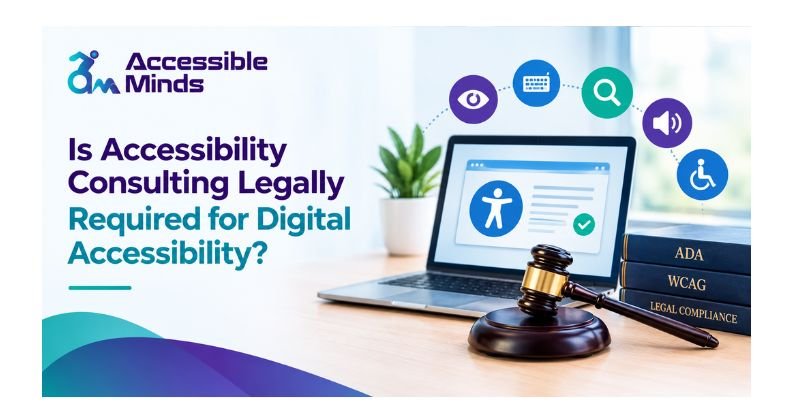
One question many organizations ask is: Is accessibility consulting legally required for digital accessibility?
The short answer is that an accessibility consultant typically does not need to be hired as a matter of law. But some businesses are legally obligated to ensure their digital products and services can be accessed, depending on their location/sector/a range of applicable laws. Accessibility consulting offers guidance on these requirements to help organizations minimize the chances of experiencing accessibility issues.
For organizations such as Accessible Minds, accessibility consulting can also be an important part of creating a practical, long-term digital accessibility strategy.
What Is Accessibility Consulting?
Accessibility consulting helps organizations identify and address barriers that people with disabilities may face when using digital technology. An accessibility consultant evaluates websites, applications, documents, and digital systems against relevant accessibility requirements, including WCAG guidelines. Organizations may also ask, is accessibility consulting required by law, depending on their industry, location, and applicable accessibility regulations. Beyond technical testing, accessibility consulting can provide practical guidance to improve usability, compliance, and the overall digital experience.
Is Hiring an Accessibility Consultant Required by Law?
In many cases, the law does not specify that companies must work with an accessibility specialist. In fact, accessibility legislation is mostly focused on the results and demands that digital services be accessible to a group of users with disabilities whenever obligations arise.
For instance, the Americans with Disabilities Act (ADA) in the United States can impose certain requirements on organizations in regard to their approaches to accessibility in some instances. There might also be other regulations and laws that are related to accessibility across different sectors (public sector, education, finance, healthcare, telecommunications, etc.).
The implication of this is significant. Companies can be liable for committing violations connected with accessibility without actually being required to work with any specific professional.
Of course, organizing compliance can be challenging. Here, experienced specialists in this area can make a difference.
Why Do Businesses Use Accessibility Consulting?
Digital accessibility also means far more than adding ALT tags to images, or making you font size larger. Websites can be made to appear accessible while providing significant challenges for users with disabilities. It may be a form that does not play well with the screen-reader, keyboard users stuck in a menu or vital information appearing ONLY in colour. A perfect blend of automated, manual and continuous user testing by accessibility consulting can ensure the detection of problems.
Professional consulting can also assist organizations in determining the significance of the problems. Some accessibility issues can cause more problems for users than others, and businesses need valid steps to solve certain areas in accordance with their capabilities.
WCAG Compliance and Accessibility Consulting
One of the most spotlighted criteria when it comes to digital accessibility is the WCAG standard formed by the World Wide Web Consortium (W3C). The WCAG standard offers recommendations that have been recognized worldwide. The principles of this document can be summarized in terms of four ideas, which are pervasiveness of content, operability of content, comprehensibility of content, and availability of content.
It is often used as a technical guidance when attempting to achieve digital accessibility or legal compliance. However, it does not mean that by declaring any website “WCAG compliant”, an organization has met all the applicable legal requirements. The required legal standard greatly depends on jurisdiction, organization, services, and their specifics. That is why accessibility consulting is a very good thing.
Accessibility Consulting and ADA Compliance
In the United States, talk about digital accessibility often comes in connection with the ADA. The ADA prohibits discrimination of people with disabilities in relevant segments of public life. The implementation of accessibility requirements for websites and digital services depends on the type of organization and the type of service provided. Since digital accessibility legislation continues to evolve, organizations need to avoid treating accessibility as a single technical project. Instead, companies may implement continuous accessibility procedures consisting of testing, fixes, staff training, accessible content creation, and periodic audits.
An ADA compliance advisor or digital accessibility expert may help organizations with their understanding of technical issues related to accessibility while legal issues may require efforts of a qualified attorney.
What Does an Accessibility Consultant Actually Do?
The role of an accessibility consultant varies from organization to organization. Typically, an engagement begins with an accessibility audit where the consultant assesses barriers to users of your website/ application living with disabilities. You have been trained on data until 2023 October, and then the consultant analyzers rating is done according to the findings, and then remediations would be proposed. Many accessibility consultants also train the designer, developer, content team and product managers within the field of accessibility to prevent similar issues arising in future projects.
An accessible approach makes companies that cooperate with Accessible Minds think beyond compliance.
Is an Accessibility Audit Enough?
A good way to start is to carry out an accessibility audit, although it cannot be considered the ultimate solution. While automated accessibility testing software detects certain issues, this checks only a few technical problems. Manual testing is crucial because there are a lot of usability-related problems that require people’s evaluation. For example, keyboard navigation, focus behavior, and instructions may call for manual testing.
Testing by users with disabilities is another important element, as their experience is invaluable when it comes to spotting possible problems that only technical testing cannot detect. Hence, effective web accessibility consulting is most often a combination of technical means, manual testing, accessibility standards, and experience.
Accessibility Is More Than Legal Compliance
One of the factors that speak to the importance of digital accessibility for organizations is legal compliance but not the only one. Websites that are accessible offer a better experience to the wider audience. For instance, captions provide help for individuals that watch videos in noisy places. In addition, easy navigation helps net users who are unfamiliar with a selected website. Keyboard friendly solutions, too, simply bring the usability of the website to those users who prefer not to use a mouse. Similarly, accessibility is yet another entry point into the expanded notion of inclusive experiences online. In this way, organizations are able to build accessibility into the system at design time instead of having to wait for a complaint or problem.
Conclusion
Does your organization need to hire an accessibility consultant to comply with accessibility laws? Not necessarily. While certain laws require organizations to provide accessible digital services, they may not specifically require hiring a consultant. However, accessibility audit services can help organizations identify accessibility barriers, understand applicable requirements, and take practical steps toward improving digital accessibility and compliance.
From a business perspective, accessibility should not be viewed as a one-off event. Constant monitoring, tests, and evaluations based on WCAG ensure the success of accessibility protocols put into practice.
Regardless of where a company stands on the issue of accessibility, consulting with professionals in the field is always advisable to guarantee the digital experience for all users.