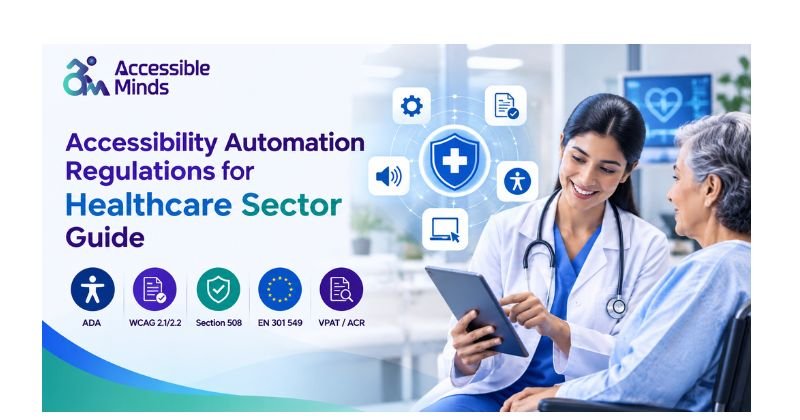
It is well-known that the healthcare sector is transitioning to become more digital at an alarming rate. Patients increasingly rely on technology for everything from booking online appointments and accessing patient portals to joining telehealth platforms and using mobile healthcare solutions. As healthcare organizations expand their digital services, understanding and following accessibility automation regulations for the Healthcare sector has become increasingly important to help ensure that these technologies are accessible to people with disabilities.
For people with disabilities, emerging technologies such as the Metaverse can present several accessibility challenges. Digital healthcare environments may create significant barriers when accessibility features are not properly considered during design, development, testing, and implementation. Addressing these barriers through automated accessibility testing and appropriate compliance practices can help healthcare providers create more inclusive digital experiences and make essential healthcare services easier for everyone to access.
This is why Accessible Minds emphasizes digital accessibility and automation of accessibility for organizations in critical sectors, including healthcare. Accessibility is not about just making things more usable; it is a necessity, everyone should be able to acquire information and services independently.
As laws have been developed through 2023, electronic medical organizations want concrete plans for discovering and solving computerized availability problems. By pushing automation to the parts of the organization that support more scalable, flexible models for delivering accessibility guidance and remediation it is possible (and not just from a cost perspective) to provide digital experiences in healthcare that really include everyone while at the same time helping with their wider diversity and inclusion goals around other areas too.
What Is Accessibility Automation?
Automation of accessibility refers to the use of technology in systematically evaluating digital products such as websites, mobile applications, and other digital content for the accessibility challenges. Using automated accessibility testing helps identify issues such as missing alt text, low color contrast, improper heading hierarchy, inaccessible forms, and many more.
At Accessible Minds, we employ accessibility automation as a part of the overall development of accessibility. On its own, the tool is capable of detecting many website accessibility problems, but it is also important for organizations to supplement this technique with manual testing, testing with assistive technology, and testing with users with disabilities.
Using this comprehensive methodology aids better understanding of the concept of accessibility in digital health.
Why Accessibility Is Critical for Healthcare
Since healthcare is one of the most dynamic sectors, accessibility becomes prominent because it lowers digital barriers and possible loss of access to health services and information.
If the fields on a healthcare website are not labeled correctly or if they are misaligned, for instance, then during an appointment booking or while looking up their health details, a patient who relies on screen readers will struggle to access information.
Likewise, patients with physical limitations rely on the keyboard and different kinds of input devices. A site that requires the use of a mouse can block them from completing necessary actions.
Patients who cannot hear also require captions or transcripts to be able to follow videos and other materials containing sound.
These examples show that making healthcare accessible must be considered basic when providing healthcare in digital form. Accessible Minds understands that accessibility can enable the development of a better healthcare system for all people.
Understanding Accessibility Regulations in Healthcare
The regulations and standards of accessibility have been specifically designed to ensure that people with disabilities can use digital services. Depending on the country in which an individual inhabits, a certain institution, or the type of health service being provided, one type of accessibility legislation or requirement may be relevant in a given case.
Web Content Accessibility Guidelines (WCAG) are among the top technological guidelines for purposes of digital accessibility. The WCAG gives recommendations regarding digital content such that it becomes visible, understandable, operable, and durable.
It is challenging for health care institutions to stay up to date on accessibility requirements. Various digital platforms have undergone numerous changes over time and minor updates of websites or software may lead to emergence of new accessibility issues.
How Accessible Minds Supports Accessibility Automation
Accessibility strategy does not mean the one-time-a-year audit. This means that as digital products in health-care industries are recurring on websites or apps, accessibility should be checked continuously. If your accessibility processes are repeatable, automation can save you a lot of effort in creating an automated testing process. Example: Automated tests can be integrated in the software developing and QA workflows. Those automated accessibility tests would have been able to highlight any issues upfront, whenever a developer came up with something new. And so accessibility can be woven into the development life cycle.
Using the ideas advocated by Accessible Minds, organizations can focus their accessibility efforts on making accessibility part of the lifecycle across development, design, content, and quality assurance.
Key Benefits of Accessibility Automation for Healthcare
1. Better Digital Patient Experiences
Websites and apps such as patient portals provide convenience to patients in tasks such as scheduling appointments, obtaining their own medical information, understanding medical content and talking to health service providers. Improving accessibility means making the patient experience easier by allowing patients to become more independent.
2. Faster Identification of Common Issues
The manual testing process around accessibility is worth the time spent on it. However, running all accessibility checks through your entire digital ecosystem takes time and effort. While manual testing will take some time to detect a few technical glitches, automated testing can identify such issues instantly and allow teams to fix those at a faster pace.
3. Continuous Accessibility Monitoring
Healthcare companies may manage numerous websites, apps, patient portals, and digital services. Accessible Minds stresses the importance of continuous accessibility. Accessibility often keeps changing due to the introduction of new content, functionality, or code.
Automation monitoring can aid organizations to discover accessibility regressions and respond to them faster.
4. Support for Compliance Efforts
Healthcare companies may manage numerous websites, apps, patient portals, and digital services. Accessible Minds stresses the importance of continuous accessibility. Accessibility often keeps changing due to the introduction of new content, functionality, or code.
Automation monitoring can aid organizations to discover accessibility regressions and respond to them faster.
5. Reduced Digital Accessibility Risk
Poor user experience occurs due to accessibility barriers, and these barriers can also pose legal, operational and reputational risk. Identifying accessibility concerns proactively minimizes the chance of creating huge barriers that can impact patients on hit.
Making Accessibility Part of Healthcare Development
The use of accessibility automation is valuable for organizations because it helps to detect connected accessibility gaps with regards to relevant accessibility standards and regulations. Despite the fact that automated testing in itself does not lead to legal compliance, it can be an integral part of the overall accessibility compliance and governance program that an organization operates.
The Future of Healthcare Accessibility
One of the best methods for improving accessibility is to design it right at the beginning, from scratch. Healthcare organizations can establish guidelines for making accessibility part of its planning and designing processes. Accessibility Testing in Implementation: It is a continuous process so developers must follow accessible coding practices and do automated tests within the implementation process. Organizations should use a combination of automated scans, manual tests, and assistive technology tests before launching the product. Following the launch, stakeholders must continue to monitor accessibility during the platform life cycle.
Why Choose Accessible Minds for Accessibility?
Accessibility goes beyond just being a technical requirement; it involves ensuring that everyone has equal opportunities to use digital services.
Accessible Minds is based on the belief that by considering accessibility crucial to their technology plans, businesses can create better digital experiences.
When it comes to healthcare organizations, this translates into not only being compliant but also thinking about the actual experiences of patients with disabilities.
Accessibility is achieved through automation of testing processes, continuous testing, accessibility assessments, and other adaptive methods..
Conclusion
As healthcare services move increasingly into the online domain, accessibility regulations specific to the healthcare sector continue to gain importance. Healthcare organizations need to ensure that their websites, mobile apps, patient portals, telehealth services, and other digital content are accessible to people with different abilities. Website Accessibility Testing Services can help organizations identify common accessibility barriers, understand users’ needs, and address issues that may prevent people from accessing essential healthcare information and services. Making accessibility a consistent part of the software development life cycle can help healthcare providers create more inclusive, usable, and accessible digital experiences.
However, automation should be a part of a larger accessibility plan that involves manual testing, assisting technologies testing, accessibility expertise, and real user feedback.Thanks to Accessible Minds, companies can take steps toward ensuring digital accessibility and creating more inclusive health care experiences.