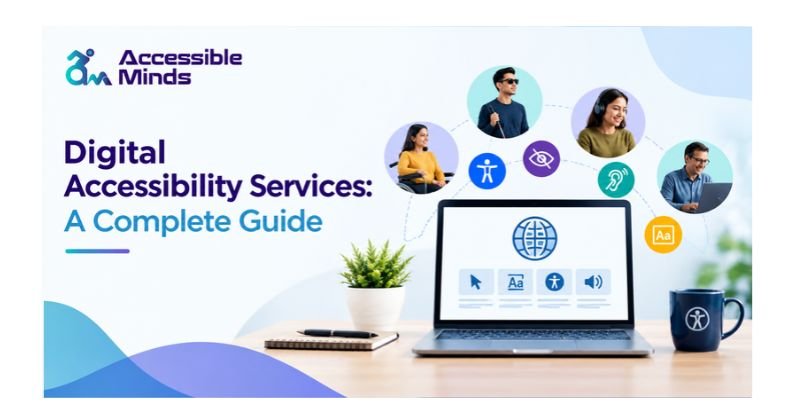
Digital experiences should be accessible to everyone, regardless of their abilities, disabilities, or the assistive technologies they use. From websites and mobile applications to digital documents and online platforms, accessibility helps ensure that every user can access information and complete essential tasks independently.
Digital Accessibility Services help businesses identify and remove digital barriers, improve usability, and create inclusive online experiences. These services are particularly important for organizations that want to reach a broader audience, improve customer experiences, and meet applicable accessibility requirements.
In this guide, we will explore what digital accessibility services are, why they matter, the different types available, and how businesses can implement effective accessibility strategies with support from Accessible Minds.
What Are Digital Accessibility Services?
Services related to digital accessibility involve technical solutions aimed at ensuring usability of the Internet sites, applications, documents and other digital solutions by people with different physical capacities. These are the problems preventing people with disabilities of visual, hearing, motor, thinking or neurological nature from interaction with digital information.
For instance, visual people must struggle with using many websites because they do not have the proper alternative text under its images. In the same way, people with motor disorders may have problems getting on the web that requires accuracy of movement of the computer cursor. Experts in digital accessibility find out about the problems and make recommendations for improvement of many solutions.
Common services include:
Website accessibility audits
Accessibility testing and evaluation
WCAG compliance consulting
Accessible website and application development
PDF and digital document remediation
Screen reader and keyboard testing
Accessibility training and ongoing monitoring
By implementing these solutions, businesses can make digital platforms easier to use for a wider range of people.
Why Are Digital Accessibility Services Important?
Digital accessibility is more than a technical requirement. It is an important part of delivering a positive digital experience and ensuring equal access to information and services.
1. Improve User Experience
Websites that are accessible make use of navigation that is easy and friendly, readable content, uniform layouts and useful feedback. These characteristics provide advantages for people who suffer disabilities as well as for individuals using websites on mobiles or in unfavorable conditions.
Taking captions as an example, these are of great help to deaf and hard of hearing people, but they also help those watching videos without sound.
2. Support Accessibility Compliance
The laws and regulations surrounding accessibility may vary based on your organization, the location of your operations, and the nature of services offered. For instance, in relation to the matter, the Americans with Disabilities Act is of importance since websites are related to it, while Section 508 is responsible for ensuring accessibility standards for federal ICT.
The WCAG is a recognized authority regarding guidelines generally accepted worldwide for better accessibility of digital information.
The professional services for digital accessibility will assist you with the application of the proper standards and how to comply with them. Nevertheless, there are no automated audits or tools that guarantee full compliance with all standards in digital accessibility.
3. Reach a Wider Audience
There are several different ways that an unreachable website can block future customers from learning about products, making purchases, or getting in touch with needs of an organization.
Removing barriers to access means that more individuals will be able to use online services independently, which would lead to a higher level of customer satisfaction and less unnecessary obstacles throughout the user’s journey.
4. Strengthen Brand Reputation
Organizations that consider inclusion to be of utmost importance showcase their determination to satisfy people’s numerous needs. Accessible digital practices allow a firm to build up a reputation of trust among clients and show that it cares about their interests. Employing the expertise of accessibility specialists helps people convey inclusive design through their digital strategy.
Types of Digital Accessibility Services
Different digital platforms require different accessibility solutions. A comprehensive strategy evaluates the entire user experience, from the website interface to supporting documents and interactive features.
Website Accessibility Audits
The evaluation of a website’s accessibility is referred to as a website accessibility audit which assesses if the accessibility of a website is impaired for the disabled.
The concerned authority evaluates the navigability, headers, visual contents, forms, colors, and means of navigation on the site.
Normally a combination of automated scanning machines and manual audit is performed for the websites.
The final report generated helps in determining the problems in order of severity and provides solutions for their solution.
Accessibility Testing Services
Accessibility testing services evaluate how well people with disabilities are able to use a digital product.
Testing techniques can consist of keyboard-only browsing, screen reader examination, browser zoom test, as well as manual review of interactive elements.
Testing in conjunction with assistive technologies helps find practical usability problems such as confusing verbal messages, unusable menus, etc.
WCAG Compliance Consulting
Consulting regarding WCAG informs businesses about accessibility standards and how they can be implemented across their online platforms.
WCAG 2.2 outlines its success measures under four principles: Perceivable, Operable, Understandable, and Robust.
Consultants’ role is in referring to the relevant measures companies need, prioritizing their implementation, and developing procedures for their continual upkeep.
Accessible Document Remediation
If PDFs, reports, presentations or documents are not structured properly, they can create obstacles for users in terms of digital accessibility.
Digital accessibility services often entail tagging documents, adjusting heading structure, changing reading orders, improving link text and testing form fields.
Such changes ensure that users of screen readers can successfully navigate the documents and comprehend their content.
Mobile Application Accessibility
Mobile accessibility service allows you to check how different apps can function for the people with various abilities.
Experts check the touch targets, screen reader labels, gestures, resize text, color contrast, and navigation to do this.
Testing takes place with the help of necessary devices and software, which may help in detecting any problems specific to some platforms.
Inaccessible mobile applications increase difficulties for users regarding their daily activities.
Key Features of Effective Digital Accessibility Services
When choosing an accessibility partner, businesses should look beyond automated reports and consider the quality of the overall process.
Manual and Automated Testing
Automated tools can rapidly identify certain types of accessibility issues, including lack of alternative text and certain contrast problems. However, these types of tools cannot assess every area of accessibility. Manual testing allows you to evaluate keyboard accessibility, whether the navigation paths within a web page are logical, how well the website works with screen readers, and whether the content is understandable for users.
WCAG-Based Evaluation
An accessibility evaluation must state the correct version of the Web Content Accessibility Guidelines and the appropriate level of compliance. Although WCAG 2.2 Level AA is generally used as a standard for compliance, what constitutes actual compliance will vary based upon the specific laws, contracts and organizational requirements.
Practical Remediation Guidance
In order to succeed it is not enough to just identify problems; we must provide developers and designers (content producers, product owners, and project managers) with specific recommendations as well. A good report will address one specific problem and explain how it affects users and the extent to which it impacts customers.
Continuous Accessibility Monitoring
The world of websites and applications is constantly changing. Accessibility issues may arise as a result of the addition of new features, tools, improvements, and other content.
Organizations can maintain accessibility compliance on a continuous basis.
How to Choose the Right Digital Accessibility Services Provider
Choosing the right accessibility service provider will lead to more effective and sustainable improvements in accessibility requirements. First, check the service provider’s experience with website screening, mobile apps development, document modification, and assistive technology testing. Find out if the provider uses both manual and automatic assessment methods.
Secondly, check the approach that the service provider uses while judging accessibility solutions. The service provider should clarify what WCAG version and conforming level is used while making accessibility judgments and how the results of the evaluation are put in order of their significance. Thirdly, look for the service provider’s reporting which does not require too much technical explanation and is understandable for both developers and decision-makers.
Finally, determine whether the service provider entails continuing customer support. The process of improving accessibility requirements is an ongoing process that needs constant checking of the digital product. Accessible Minds is the name to remember while searching for an appropriate service provider for accessibility services. Organizations that consider a partnership with Accessible Minds should learn about their services and how they will meet the needs of the organization.
How Businesses Can Get Started With Digital Accessibility
The process of enhancing accessibility in organizations can commence through the following actions.
Evaluation of existing digital assets: This involves identification of essential platforms, applications, documents, etc., which need to be evaluated.
Carrying out an accessibility audit: This consists of the merging of the automated tools and manual evaluation to check for hindrances.
Prioritization of key issues: This includes finding and fixing issues which hinder movement or understanding of individuals faced with issues.
Take corrective measures: This involves working alongside developers and content specialists.
Re-testing: This requires ongoing evaluation with the help of keyboard navigation and assistive technology.
Ongoing process: This includes the incorporation of accessibility within the design review process, development processes, and employee training.
Conclusion
Services for digital accessibility assist businesses in developing inclusive digital experiences by identifying barriers, enhancing usability, and helping with accessibility practices. These services include services like site auditing and WCAG advice, mobile app testing, and document remediation, with all of these approaches having the purpose of digital accessibility.
Organizations have to see accessibility as a continuous process rather than a technical task completed once, otherwise, they will experience all issues of a digital playground.
If organizations study accessibility programs and solutions suggested by Accessible Minds, they will take educated steps towards the development of inclusiveness in the digital field.