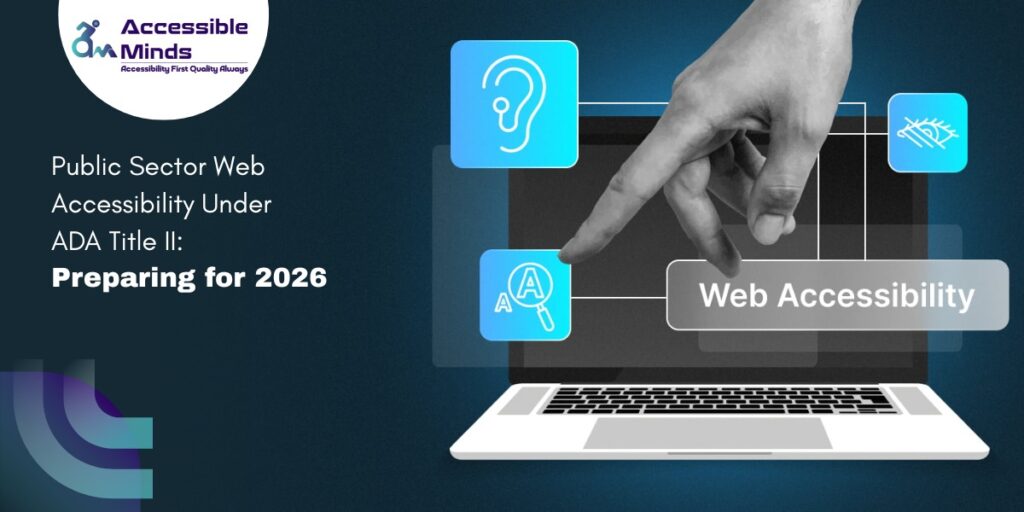
In an increasingly digital world, public sector organizations must prioritize accessible online experiences to ensure that everyone regardless of ability can access essential government services. With the Americans with Disabilities Act (ADA) Title II web accessibility requirements taking effect in 2026, preparing now is critical for state and local governments. This blog explores why ADA Title II matters, what it requires, and how public sector teams can leverage digital accessibility services to meet compliance successfully.
Understanding ADA Title II and Its Impact on the Public Sector
Title II of the ADA prohibits discrimination against individuals with disabilities by public entities which include state and local governmental agencies, public universities, transit authorities, and other government-run organizations. Traditionally, these obligations have applied to physical and programmatic aspects of government services. The latest update goes a step further by explicitly mandating web and mobile accessibility under clear technical standards.
In April 2024, the U.S. Department of Justice finalized a new rule that specifies the Web Content Accessibility Guidelines (WCAG) 2.1 Level AA as the technical standard for accessible web content and mobile applications provided by public entities. This means that all websites, digital documents, and mobile apps must be designed and maintained so that people with visual, auditory, cognitive, and motor disabilities can access them effectively.
Compliance is not optional. For large public entities serving populations of 50,000 or more, the deadline is April 24, 2026. Smaller entities, and special districts, have until April 26, 2027 to align with the same standards.
Why Web Accessibility for Public Services Matters
Web accessibility isn’t just a legal checkbox. It supports equitable access to government services such as:
- Registering to vote
- Accessing tax and benefit information
- Applying for permits
- Using online payment portals
- Viewing public records
When online content isn’t accessible like images without alternative text, documents that screen readers can’t parse, or forms that aren’t keyboard navigable it creates real barriers for people with disabilities. These obstacles can prevent full civic participation and access to vital resources.
Beyond community impact, non-compliance introduces legal, reputational, and operational risks. Public bodies could face complaints, regulatory reviews, and the cost of last-minute remediation if they fail to show ongoing compliance efforts.
Key Accessibility Requirements Under ADA Title II
At the heart of Title II web accessibility compliance is WCAG 2.1 Level AA, a globally recognized standard that outlines clear criteria for accessibility. Major requirements include:
- Text alternatives for non-text content (e.g., images must have alt text)
- Keyboard accessibility for users who cannot use a mouse
- Sufficient color contrast for visual legibility
- Descriptive headings and labels to guide navigation
- Accessible forms with logical tab order and error messages
The rule applies to all content a public entity provides or makes available, including content produced by external vendors or contractors. That means oversight of procurement and third-party tools is essential.
Preparing for Compliance with Strategic Planning
Preparation is key. Compliance deadlines might seem far off, but meeting ADA Title II requirements is not a one-time task, it’s a shift in mindset and process. Public sector digital teams should begin planning now with the following strategic steps:
1. Conduct a Detailed Digital Audit
Before you can fix accessibility issues, you must know where they are. Comprehensive accessibility audits both automated and manual are essential for assessing current web content, applications, PDFs, and media assets. This establishes a baseline for improvements and identifies priority areas for remediation.
Leverage digital accessibility services from experienced vendors to conduct detailed evaluations, uncover nuanced accessibility gaps, and provide actionable insights.
2. Train Teams Across Functions
Accessibility competence shouldn’t be siloed. Developers, content authors, UX designers, and procurement teams must understand accessibility principles to prevent new violations. Internal training supported by external digital accessibility solutions like workshops or e-learning helps embed accessibility into regular workflows.
3. Integrate Accessibility into Procurement and Contracts
Public entities must ensure that any third-party digital products they purchase meet accessibility standards. Contract language should clearly state accessibility expectations, and vendors should be evaluated based on their ability to deliver compliant solutions.
4. Prioritize Remediation Work
Work with your audit results to prioritize fixes that deliver the most impact starting with services that are most frequently used or that affect critical public access (e.g., application portals). Set realistic milestones and use available digital accessibility services to scale remediation efforts.
5. Establish Continuous Monitoring
Accessibility is ongoing. Use monitoring tools and periodic reassessments to ensure that future content additions remain compliant. This might involve automated scanners, user testing, and policy enforcement across teams.
Leveraging Professional Digital Accessibility Services and Solutions
Meeting ADA Title II standards is a technical and operational challenge. It often goes beyond the capacity of internal staff, especially for smaller entities with limited resources. Partnering with specialized digital accessibility services providers can accelerate compliance.
These services often include:
- Accessibility audit and gap analysis
- Remediation planning and implementation
- User testing with assistive technology
- Staff training and certification
- Accessibility policy development
Similarly, digital accessibility solutions such as evaluation tools, accessibility overlays (used carefully and as part of broader remediation), and compliance dashboards can support continuous accessibility management.
Conclusion: Make Accessibility a Sustainable Priority
Preparing for ADA Title II compliance by 2026 isn’t just about avoiding penalties, it’s about fulfilling a commitment to equal access for all community members. Public sector entities that invest in accessibility early, use effective digital accessibility services, and adopt holistic digital accessibility solutions will not only meet legal requirements but also deliver better, more equitable online experiences for everyone.
By embedding accessibility into digital planning, procurement, design, and operations now, public organizations can turn compliance into inclusion and leadership in accessible public service delivery.