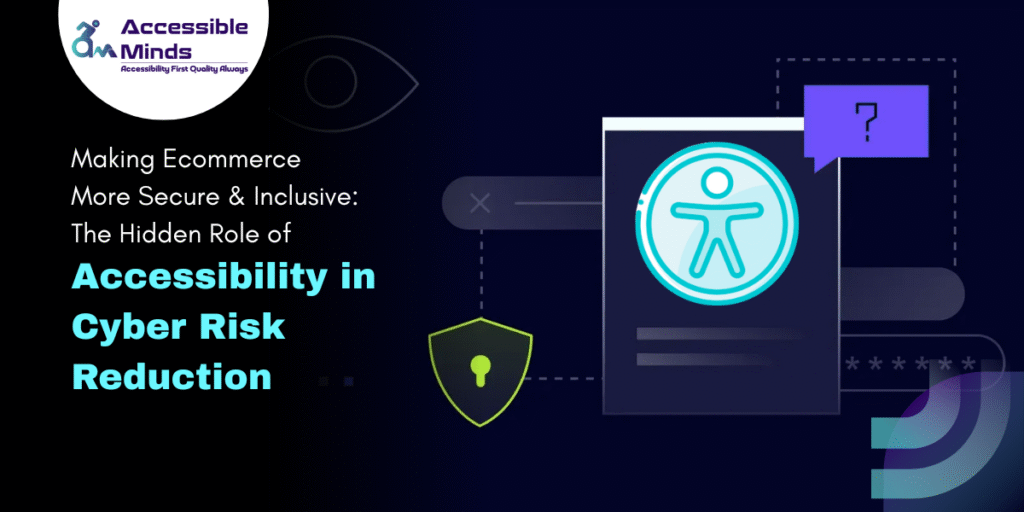
As ecommerce continues its rapid global expansion, the stakes for security and user experience have never been higher. Attackers are using increasingly sophisticated methods from AI-powered phishing and credential theft to supply-chain exploits and ransomware to steal customer data, disrupt services, or extort businesses. Meanwhile, savvy consumers expect inclusive, accessible experiences.
This convergence spotlights a powerful truth: accessibility and security aren’t separate goals, they reinforce each other. When ecommerce platforms adopt digital accessibility solutions and invest in Accessibility Testing Services, they don’t just become more usable for people with disabilities they often become harder to exploit, less error-prone, and more resilient against modern attack vectors.
At the same time, comprehensive vulnerability assessment and penetration testing (VAPT), Website Security Testing Services, and Mobile App Security Services remain indispensable to defend against infrastructure-level threats. When these two layers of accessibility and technical security are combined, ecommerce platforms can achieve a robust, future-proof posture.
Below, we explore the 2024–2025 threat landscape, real-world breach case studies, and a comprehensive roadmap for building more secure, inclusive, and trust-worthy ecommerce experiences.
The 2024–2025 Threat Landscape: Why Ecommerce Is Under Siege
A staggering global cost of cybercrime
- Cybercrime is projected to impose a global cost of US $10.5 trillion annually by the end of 2025. This reflects direct losses, remediation costs, reputational damage, and downstream ripple effects across industries. Source
- In 2025, the global average cost of a data breach has been estimated at US $4.44 million, even though some regions notably the United States continue to see far higher costs. In the U.S., the average breach cost reached US $10.22 million this year.
For ecommerce businesses where customer data, payment information, and transaction records are abundant these figures aren’t abstract. A single breach can inflict catastrophic financial and reputational damage.
Evolving attack vectors: credential abuse, AI-powered fraud, third-party exposure
- Credential theft and reuse remain a top attack method, often via phishing or credential-stuffing campaigns. Especially when users reuse passwords across sites, or when password-reset flows are weak, attackers can gain broad access with little resistance.
- In 2025, threat actors have increasingly turned to AI-powered techniques: hyper-realistic phishing emails, voice-cloning deepfakes, vishing attacks to impersonate trusted sources. These methods exploit human trust and social engineering more than technical vulnerabilities.
- Third-party dependencies and supply-chain risks are another growing concern. Many ecommerce platforms rely on external services, cloud providers, or plugins. A breach in any vendor can cascade into serious data exposure, a top concern highlighted in recent industry analyses.
- Meanwhile, ransomware remains a massive threat: 2025 has seen a surge in ransomware incidents targeting consumer-facing services, including retail and ecommerce.
Human error and usability shortcomings- often the weakest link
Security tools and firewalls help, but a large share of breaches trace back to human error: misconfigured servers, poorly managed credentials, unclear UI workflows, weak or confusing authentication flows, or insufficient user education.
Poor usability is more than a nuisance in many cases, it’s a vulnerability. For ecommerce platforms, complex or ambiguous checkout flows, unclear password-reset interfaces, or inaccessible forms can lead to mistakes that expose data or open doors for attackers.
It’s here that accessibility often dismissed as a compliance formality shows its deeper value.
What Is Digital Accessibility And Why It Matters Beyond Inclusion
Digital accessibility refers to designing websites and apps so they can be used by everyone including people with disabilities (visual, motor, cognitive) but its benefits go far beyond compliance or inclusivity.
Accessible design emphasizes:
- Semantic, clean HTML structure and markup
- Clear, consistent navigation and layout
- Proper labels, alt text for images, descriptive links
- Keyboard-only navigation for interactive elements
- Readable text, clear contrast, and understandable instructions
- Predictable, logical interface flows
These features central to many digital accessibility solutions impose structure and clarity on the user interface. That clarity, in turn, reduces friction, reduces user errors, and can help prevent data mishandling or misuse.
Moreover, when combined with rigorous Accessibility Testing Services (or Digital Accessibility Testing Services), these design constraints often help surface UI inconsistencies or hidden edge cases some of which may hide security hazards (e.g., ambiguous form inputs, unclear error messages, unvalidated fields).
In short: accessible design isn’t just about accommodating assistive technologies it’s about making interactions predictable, reliable, and secure.
Recent Ecommerce Breaches: Case Studies from 2024–2025
To understand how real-world failures illustrate the need for security + accessibility, let’s look at some recent high-profile incidents.
Coupang (South Korea) — 33.7 million accounts exposed (Nov 2025)
- In late 2025, the popular ecommerce platform confirmed a breach that exposed personal data of 33.7 million customer accounts including names, email addresses, phone numbers, shipping addresses, and order histories. Source
- The breach reportedly began on June 24, 2025 through overseas servers, but remained undetected until November 18 nearly five months later.
- Payment data and login credentials were reportedly not compromised.
Lessons & Relevance
Even though financial data remains safe, the leak of personal identifiers is enough to fuel large-scale phishing campaigns, identity theft, or social engineering. Attackers can exploit this PII to impersonate users, hijack accounts elsewhere, or launch targeted scams.
If Coupang had combined regular Website Security Testing Services with strict data access governance and layered on digital accessibility solutions to ensure clear, user-friendly notification flows (for breach alerts, password resets, etc.) they could have given their users faster, more accessible means to respond. Moreover, better authentication and account-management interfaces (accessible to all) would make it easier for users to detect anomalies, enable additional security measures, or respond to communications.
Dukaan (India) — Data leak via unsecured Apache Kafka instance (2025)
- In 2025, reports revealed that Dukaan (a popular platform for small merchants) suffered a serious leak due to an unsecured Apache Kafka instance. The misconfiguration reportedly exposed payment gateway tokens for services like Stripe, PayPal, and RazorPay. Source
- The leak allegedly affected over 3.5 million merchants and approximately 16 million customers and, alarmingly, the vulnerability remained undetected for over two years.
Lessons & Relevance
This breach underscores how backend misconfigurations, especially in third-party services can undermine even the most hardened front-end. While accessibility cannot directly prevent such server-side misconfigurations, an inclusive design mindset can encourage better documentation, clearer admin workflows, and structured UI for configuration making it less likely for sensitive infrastructure to be accidentally exposed.
Moreover, combining Mobile App Security Services and Website Security Testing Services with periodic configuration audits and vulnerability assessment and penetration testing (VAPT) would likely have flagged such critical misconfigurations long before the leak occurred.
Broader Retail & Luxury Sector Leaks — 2024–2025 Surge in PII Exposures
- According to aggregated 2025 breach reports, many global retail and luxury-brand conglomerates (including high-end fashion houses) have been hit by data leaks exposing customer PII names, emails, phone numbers, addresses, purchase history, and more. Often, attacks exploited third-party vendor platforms or supply-chain vulnerabilities rather than direct payment systems.
- A recent academic study revealed that nearly 30% of online shops leak user data to third parties often without clear user consent or visibility.
Lessons & Relevance
These latent leaks, especially when PII is aggregated across platforms, create fertile ground for large-scale phishing, identity theft, or credential abuse campaigns. Accessible design can help by providing transparent privacy notices, clear consent flows, easy-to-use account dashboards, and accessible data-management tools.
Meanwhile, rigorous vulnerability assessments, frequent security audits, and disciplined third-party governance are essential to shore up backend weaknesses.
How Accessibility + Security Complement Each Other: A Unified Defense
Structured, predictable design lowers user error and misuse
Accessible design forces discipline: semantic markup, consistent navigation, meaningful labels, clear forms, predictable flows. These reduce confusion, minimize user mistakes (like mis-entering sensitive data), and cut down instances where users might inadvertently expose private information.
In ecommerce, clarity matters a lot during registration, checkout, payment, password reset, or account recovery. Accessible design reduces ambiguity, making each step predictable, audit-friendly, and user-friendly.
Dual testing recovers both usability and security flaws
Running Accessibility Testing Services / Digital Accessibility Testing Services alongside Website Security Testing Services and Mobile App Security Services adds a dual audit layer, one focusing on usability and inclusion, the other on technical security.
This two-pronged testing approach helps:
- surface UI inconsistencies (unlabeled fields, hidden form controls, broken navigation) that may also mask security issues
- ensure authentication, authorization, and data-input fields remain accessible and sanitized
- detect edge cases where accessibility workarounds (e.g., keyboard navigation, screen reader flows) bypass typical UI guards or are improperly handled
Together, these audits improve both the security hygiene and usability resilience of the platform.
Inclusive authentication & recovery flows that all users can use reducing support friction and security workarounds
Security often depends on authentication, MFA, password reset, and account-recovery flows. But these are frequently built without accessibility in mind. CAPTCHA widgets, complex multi-step flows, or visual-only instructions can be barriers for users with disabilities, leading to support requests, insecure workarounds (like sharing credentials), or abandonment.
By designing accessible flows with screen-reader friendly instructions, keyboard navigation, alternative MFA methods (e.g., email-based, token-based, biometric), clear error messages platforms ensure all users can access secure features, reducing chances of misuse or social-engineering attacks.
Transparent communication, better incident response, and higher trust especially for all user segments
In the wake of a breach, clear, accessible notifications matter. Accessible newsletters, in-site alerts, or account-management dashboards ensure that even users relying on assistive technologies get timely information and guidance.
This not only helps users respond effectively (change passwords, enable MFA, monitor accounts) but also preserves trust and reduces support load. In many recent breaches, slow or unclear communication has worsened fallout especially for vulnerable user segments.
Code quality, consistency, and maintainability accessibility drives discipline that cross-pollinates with secure development
Implementing accessibility correctly requires clean, semantic code, modular components, consistent UI practices, proper labelling and ARIA roles. These same qualities make code easier to review, audit, test, and secure.
Thus, accessibility often becomes a proxy for good engineering hygiene. When teams respect semantic structure, code organization, and standardized patterns, it’s easier to integrate vulnerability scanning, input validation, secure authentication, and patching which all underpin strong security posture.
A Practical Roadmap: Building Secure + Accessible Ecommerce Platforms
Here’s a step-by-step framework for ecommerce businesses to build platforms that are both secure and inclusive:
Step 1: Baseline Security Infrastructure, code, and third-party hygiene
- Perform regular vulnerability assessment and penetration testing (VAPT) on both web and mobile platforms.
- Use dedicated Website Security Testing Services and Mobile App Security Services to find weaknesses input validation, authentication, data storage, encryption, API misuse, server misconfiguration, third-party dependencies.
- Segment environments (development, staging, production), enforce least-privilege access, and adopt secure credential & secret management practices.
- Monitor and govern third-party components dependencies, plugins, SaaS integrations, vendor-hosted services, cloud services. Many 2025 breaches root in third-party exposure or misconfigured services.
Step 2: Implement Digital Accessibility from Day One
- Adopt digital accessibility solutions early in design: semantic HTML, ARIA roles, proper labels, alternative text, keyboard navigation, contrast, clear navigation, consistent layouts.
- Prioritize accessibility in design systems and component libraries so it becomes a default rather than an afterthought.
- Ensure key user flows registration, login, checkout, payment, authentication, account recovery are accessible, understandable, and operable by all users.
Step 3: Dual Audit Pipeline- Security + Accessibility
- Integrate Accessibility Testing Services (or Digital Accessibility Testing Services) into QA cycles alongside security audits.
- For every release: run accessibility tests (manual + automated), run security scans (static analysis, dynamic testing, dependency checks), follow with penetration testing if major changes occurred.
- Track both accessibility compliance and security vulnerabilities in an integrated dashboard to ensure neither area is neglected.
Step 4: Build Accessible & Secure Authentication & Data-Input Flows
- Design login, MFA, password-reset, account recovery flows to be accessible screen reader–compatible, keyboard navigable, with plain-language instructions and alternative methods.
- Avoid purely visual CAPTCHAs; consider accessible alternatives (audio CAPTCHA, honeypot fields, SMS/phone/email-based verification, time-based MFA).
- Ensure all data input is validated, sanitized, encrypted; implement strong backend protections (rate limiting, throttling, logging).
Step 5: Transparent, Accessible Communication & Incident Response
- Maintain account-management dashboards where users can view, manage, and update their data. Ensure these dashboards are accessible.
- Provide privacy notices, consent flows, and data-use disclosures in accessible formats.
- In case of a breach: issue notifications and remediation instructions in accessible channels. Provide clear guidance, easy-to-follow steps, and alternate contact/support modes for users with disabilities.
Step 6: Governance, Training, and Continuous Monitoring
- Treat security and accessibility as part of the same compliance and quality governance program.
- Train developers, designers, QA engineers, support staff not just on security best practices, but also on accessibility awareness.
- Conduct periodic audits both security (technical) and accessibility (usability) especially after major UI changes, third-party integrations, or platform upgrades.
- Use behavior analytics, anomaly detection, and logging to monitor for suspicious activity (credential abuse, abnormal payment patterns, repeated failed logins, bot-like behavior).
The Business & Strategic Case: Why Organizations Should Care
Lower breach risk and lower cost when breaches occur
Given that the global average cost of a breach in 2025 is about US $4.44 million and far higher in sensitive markets, even reducing the likelihood of a breach by a few percentage points is valuable. With integrated security and accessibility practices, companies can curtail human-error vectors, social-engineering susceptibility, and third-party misconfigurations thus lowering their overall risk.
Moreover, a robust, structured system helps in faster containment and safer remediation, cutting the scale and cost of breach impact.
Better user experience, inclusivity, and conversion rates
Accessible ecommerce sites cater to a wider audience: persons with disabilities, mobile users, people on low-bandwidth or older devices, and those using assistive technologies. This increases reach, improves engagement, and reduces friction translating into better conversion rates, fewer abandoned carts, and higher customer satisfaction.
Clear, usable checkout and authentication flows reduce drop-off, increase completion rates, and foster trust.
Better brand reputation, compliance, and long-term resilience
In an era when data privacy, security, and inclusivity are under public scrutiny by regulators, users, and civil society brands that take both security and accessibility seriously stand out. They reduce legal risk, build customer loyalty, and insulate themselves from reputational damage.
In addition, accessible codebases and disciplined engineering practices scale better and adapt more readily as platforms evolve making future expansion, integration, and compliance more manageable.
Future-proofing against evolving threats
As attackers increasingly use AI-powered attacks, supply-chain exploits, credential stuffing, and third-party vulnerabilities, a dual-layered approach gives businesses a strategic advantage. Accessible design reduces human error and misuse; technical security controls address infrastructure risks. Together, they create a resilient, adaptive defense suited for a rapidly shifting threat landscape.
Challenges and Misconceptions And How to Address Them
Despite the clear advantages, many ecommerce organizations hesitate to integrate accessibility into their security strategy. Here are common objections and how to rebut them.
“Accessibility is just for compliance or special-needs users.”
That’s an outdated perspective. While inclusivity remains a key goal, accessibility also inherently improves clarity, reduces complexity, and enforces design discipline which directly reduces security risk and user error.
When accessibility is built in from the start, it becomes part of a broader strategy for usability, reliability, and safety.
“Accessibility slows down development and delays time-to-market.”
Not necessarily if integrated early. When accessibility is baked into design systems and component libraries from the beginning, marginal cost is minimal. Also, combining accessibility testing with security audits in a unified pipeline ensures that both code quality and compliance move together, rather than as separate phases.
“Security and accessibility sometimes conflict e.g. CAPTCHAs, 2FA, anti-bot measures may be inaccessible.”
This is a valid concern but modern security design can and should account for accessibility. For example:
- Provide alternative CAPTCHA options (audio, logic-based, honeypots) or use CAPTCHA-less bot detection.
- Use accessible MFA methods SMS/email-based codes, authenticator apps with screen-reader support, FIDO or hardware-token–based methods, biometric options.
- Build accessible error messages and recovery flows, so all users regardless of abilities can complete secure workflows.
With thoughtful design and proper testing, security and accessibility can reinforce, not conflict.
“Third-party tools and plugins break accessibility or security best practices.”
It’s true many third-party components introduce accessibility violations or security gaps. That’s why vendor governance, careful evaluation, and regular audits are critical.
Accessible design encourages modular, maintainable code which makes it easier to swap out risky plugins, check dependencies, and enforce code hygiene. Combining this with Website Security Testing Services or Mobile App Security Services helps catch vulnerabilities early.
Where Accessibility & Security Meet- Concrete Use Cases for Ecommerce
Here are several areas where combining accessibility and security yields strong benefits for ecommerce platforms:
Accessible Authentication & Checkout
- Login / Signup / Password reset flows should all be keyboard-navigable, screen-reader friendly, with clear labels.
- Multi-factor authentication (MFA) options should be accessible and avoid purely visual CAPTCHAs; provide alternative methods.
- Payment and checkout screens: clear fields, validation error messages, and helper texts make sure users input correct payment or shipment info reducing input mistakes, failed payments, and abandoned carts.
Account Management & Privacy Controls
- Users should be able to easily see saved addresses, payment methods, order history, data permissions, and privacy settings all via accessible dashboards.
- Privacy-toggle controls, consent management, and data update options should be accessible for all users, ensuring compliance and user empowerment.
Notification & Incident Alerts
- In case of a breach, accessible notification systems (emails, in-app alerts, banner messages) ensure all users including those using assistive tech receive timely warnings and instructions.
- Clear, plain-language guidance ensures users understand what to do (change password, enable MFA, monitor accounts) reducing potential damage from stolen PII.
Admin & Merchant Tools (for marketplaces)
- For multi-vendor or marketplace platforms (like Dukaan or similar), accessible configuration tools ensure sellers manage payment tokens, configuration, shipping settings, data compliance, and access control without confusion.
- This reduces accidental misconfiguration of critical infrastructure (e.g., message brokers, APIs, tokens), which if left unchecked can lead to large-scale leaks.
A Holistic Implementation Framework
To embed this dual approach inside an organization, here’s a high-level framework:
- Leadership & Governance Layer
- Appoint cross-functional leads (security, accessibility, product, compliance) to own a unified “Security + Accessibility” program.
- Define KPIs e.g., % of accessible pages, # of security audits per quarter, # of third-party dependencies scanned, time to remediate vulnerabilities, user-reported accessibility issues, etc.
- Provide training for developers, QA testers, product designers, and support staff on both security and accessibility best practices.
- Appoint cross-functional leads (security, accessibility, product, compliance) to own a unified “Security + Accessibility” program.
- Design & Development Layer
- Build or adopt accessible component libraries and design systems (semantic HTML, ARIA support, keyboard navigation).
- Maintain clean, modular, and documented code.
- Enforce secure coding practices, input validation, encryption, secure storage, and secrets management.
- Build or adopt accessible component libraries and design systems (semantic HTML, ARIA support, keyboard navigation).
- Testing & Quality Assurance Layer
- For every release: run Accessibility Testing Services / Digital Accessibility Testing Services, plus Website Security Testing Services or Mobile App Security Services and vulnerability scans (static and dynamic).
- Periodically conduct full VAPT cycles, especially after major changes or third-party updates.
- Including real users (including those using assistive technologies) in usability and accessibility testing this often brings out edge cases that automated tools miss.
- For every release: run Accessibility Testing Services / Digital Accessibility Testing Services, plus Website Security Testing Services or Mobile App Security Services and vulnerability scans (static and dynamic).
- Operations, Monitoring & Third-Party Governance
- Continuously monitor infrastructure, APIs, third-party integrations, vendor access, logs, and behavior analytics.
- Enforce regular patching, credential rotation, and access audits.
- Require third-party vendors to meet strict security and accessibility requirements and keep a vendor inventory and audit schedule.
- Continuously monitor infrastructure, APIs, third-party integrations, vendor access, logs, and behavior analytics.
- User Experience & Communication Layer
- Provide accessible dashboards for account management, privacy settings, and user data.
- Implement transparent privacy disclosures, consent flows, and clear instructions for password changes, account recovery, and breach response.
- Maintain inclusive support channels (email, chat, phone, accessible help docs) that serve all users.
- Provide accessible dashboards for account management, privacy settings, and user data.
Conclusion: Accessibility and Security- Two Sides of the Same Coin
In 2025, the cybersecurity threat landscape is more dangerous and dynamic than ever. The global cost of cybercrime is projected at US $10.5 trillion per year; the average data breach now costs US $4.44 million globally, and far more in high-risk markets. Ecommerce platforms continue to be prime targets for credential theft, AI-powered phishing, ransomware, and supply-chain exploitation.
But these challenges also highlight an opportunity, a strategic advantage: by embracing both inclusive design through digital accessibility solutions and robust technical defenses via VAPT, Website Security Testing Services, Mobile App Security Services, and secure infrastructure governance, ecommerce businesses can build platforms that are safer, more usable, and future-proof.
Accessible design reduces user confusion and error, simplifies workflows, enhances clarity, and promotes code hygiene all of which reduce the human-factor vulnerabilities most attackers exploit. Combined with security testing and continuous vigilance, this dual approach dramatically reduces risk, supports compliance, and fosters customer trust.
Real-world breaches at platforms such as Coupang and Dukaan, and the broader retail sector in 2024–2025, show that data exposure and misuse of personal information are often driven not just by technical faults but by complex chains of misconfigurations, third-party dependencies, and usability gaps.
For ecommerce businesses whether established global marketplaces or emerging vendors the time to integrate accessibility and security is now.
By doing so, companies not only protect their infrastructure, data, and customers they also build trust, foster inclusivity, and create resilient digital experiences that stand the test of time.